MURMURATION REVIEWS
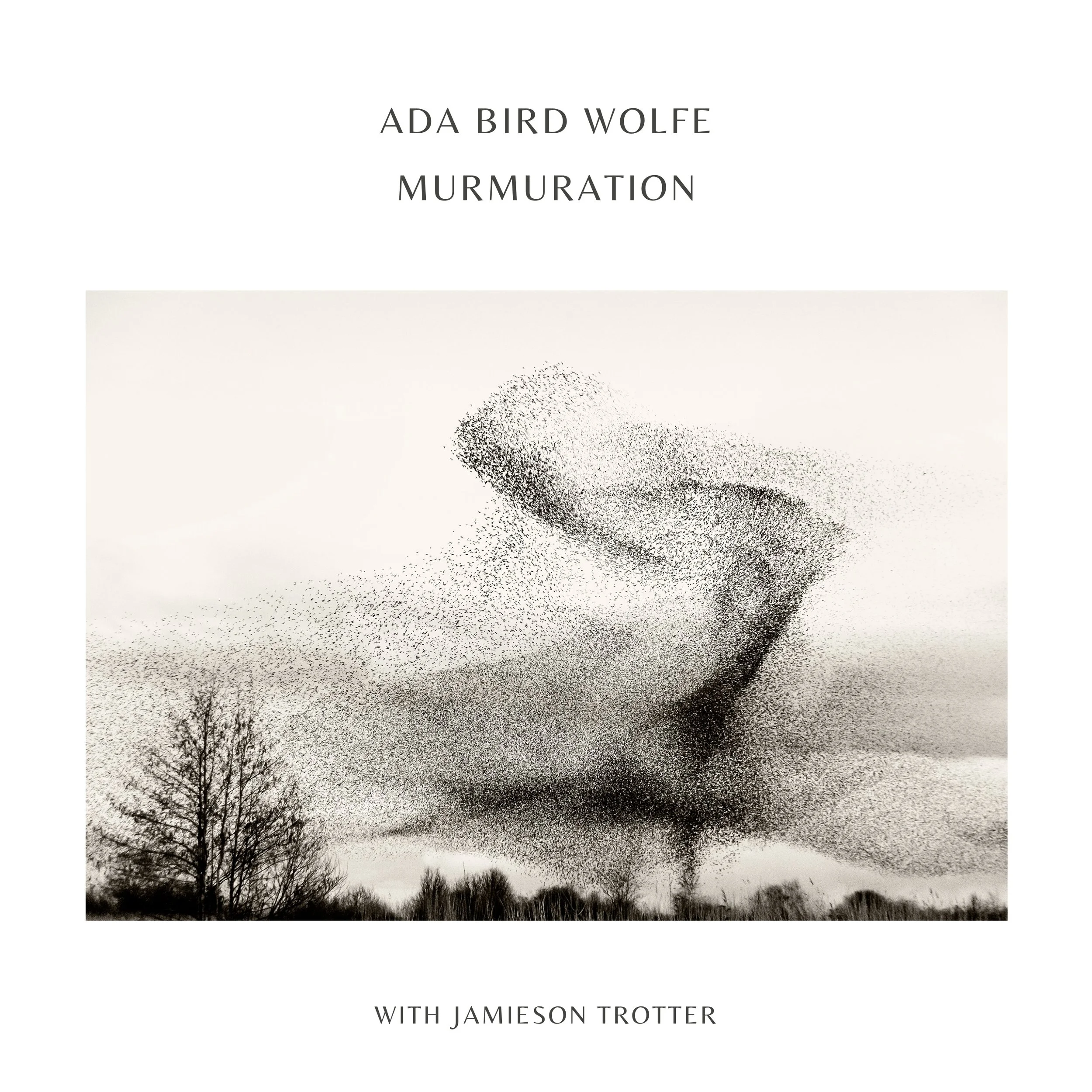
Ada Bird Wolfe with Jamieson Trotter: Murmuration
By C. Michael Bailey | Wild Mercury Rhythms
The deep, decades-long partnership between Los Angeles-based vocalist Ada Bird Wolfe and pianist Jamieson Trotter reaches a natural pinnacle on their June 2026 album, Murmuration. The duo has spent years cultivating a distinct musical language characterized by Wolfe’s sensitive and informed composing coupled with her keenly realized lyrics. Trotter proves a vocal accompanist in the same class as Tommy Flanagan, Jimmy Rowles, Hank Jones, and Ralph Sharon. The two artists have something greater than mere symbiosis; they share a deeply empathic and nuanced understanding of one another that few other duet partners can boast.
Wolfe’s path to the jazz stage is unconventional. Raised a multi-instrumentalist in Massachusetts, she earned a degree in Philosophical Psychology from the University of Chicago before relocating to California. After years away from music, she returned full time to her calling in 2010. Known for her rich, conversational contralto, Wolfe has carved out a unique niche as a brilliant composer and lyricist, with a special talent for vocalese, writing clever and interesting lyrics to fit complex, wordless melodies by jazz giants like Miles Davis and John Coltrane. She is a master of this specialized flavor of jazz vocals. Her 2018 debut album, Birdie (Self Produced), quickly earned critical acclaim.
Trotter brings an impressively complete toolbox to his role as an accompanist. A piano prodigy who began playing before age five, he is a sought-after Los Angeles session musician, arranger, and musical director who has worked with Mark Winkler, Gary Brumburgh, Carol Bach-y-Rita, and Laura Jane. The pianist’s versatility allows him to move effortlessly between hardcore bebop, film scores, and high-profile Hollywood events like the Academy and Emmy Awards Governors Balls. As an accompanist, Trotter balances angular, exciting chord structures with a spacious, delicate atmosphere that gives vocalists infinite space and complete freedom.
The two first connected in the late 2010s when Trotter became the musical director for Wolfe’s live sets and anchored her debut album. Recognizing a rare chemistry, they stripped away the backing band to record He & Me (Self Produced, 2020), an intimate duet album highlighting their shared love for the quirky rhythms of Thelonious Monk. When the 2020 COVID 19 pandemic lockdowns halted live performances, they established a strict weekly routine over Zoom, bouncing melodies, lyrics, and arrangements back and forth. This fertile isolation yielded 45 original songs. Twelve became the 2022 album Odd Bird (Self Produced), quickening Wolfe as a superb composer and lyricist and Trotter a keenly perceptive accompanist.
Trotter’s contributions to arranging increase the IQ of the music by incorporating hard-bop deconstruction and re-harmonization; he frequently flattens frantic bebop tempos to give Wolfe’s dense lyricism room to breathe. Influenced by the jagged chord voicings of Jaki Byard, Trotter avoids obvious root notes to keep the music fluid. On Miles Davis’s “ESP” (reimagined as “Mind to Mind”), his jumpy, erratic keys challenge Wolfe’s delivery, matching her conversational “talk-singing” style.
Trotter flips the emotional intent of standard covers through clever mood deconstruction. For Paul McCartney’s “Blackbird,” he halved the original tempo and mimicked literal bird calls on the piano, unearthing a deep, melancholy gravity. On Dizzy Gillespie’s traditionally explosive “A Night in Tunisia,” he stripped away the frantic Afro-Cuban percussion for a delicate, classical nocturne atmosphere that spotlights Wolfe’s low alto register.
This structural subversion drifted into the pair’s original material. On “Odd Bird Bop,” dense philosophical lyrics contrast with crystalline, jagged rhythms. For the humorous “Too Much Stuff,” sudden, sharp instrumental bursts punctuate the cautious blues arrangement. Conversely, on the politically heavy “Ordinary Man,” they abandoned complex jazz theory altogether, using sparse piano keys to let the raw weight of Wolfe’s voice command the room.
Murmuration stands as the latest epoch in this evolution, built on a decade of shared stages and an intuitive musical shorthand. However, this recording differs from its predecessors. Unlike the eclectic standards of He & Me or the loose, pandemic-born reflections of Odd Bird, Murmuration is a cohesive, 12-song conceptual celebration of life modeled after the annual life cycle of birds.
Musically, the album departs from traditional acoustic jazz to explore a thrilling cross between jazz and classical genres. The tracking represents their most complex formal writing to date, alternating tightly composed, fully notated passages with wide-open spaces for pure, unscripted improvisation. By utilizing nature as an overarching metaphor, Murmuration pushes the duo past the standard singer-and-pianist dynamic, resulting in an album where the arrangements mimic the fluid, soaring movements of birds in flight.
“Brilliant crossover jazz songs about birds and nature, most with fabulous vocals, including two by up-and-coming artist Maya Proulx, and two with Wolfe herself. The melodies and rhythms are so interesting! Favorite track: Spring Is.”
— Riegelstamm | Bandcamp
"This is one beautiful composition with dynamic, evocative sound and mood."
— Don's Tunes
"I honestly do not have enough words to describe how incredible (A Puff of Air) is. The massive amounts of musical elements, combined with their flawless execution, truly make this piece phenomenal."
— Maxi Sckell
"A nice slice of contemplative, quiet moment/late night/Sunday morning jazz that floats unhurriedly through the speakers."
— The Slow Movement
"Feels confident and detailed. Five Stars."
— Crashtest Recordings